

GLP's Or The Big 3 As I Call Them. Semaglutide, Trizaptide, and Retatrutide
A breakdown of the different GLP medications and what makes them that way. Luckily I won't have to kill you if I tell you.
SUPPLEMENTS & MEDICATIONS
2/26/20265 min read

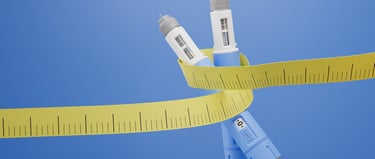
The Big Three, as I call them.
In today's class, we will be learning the different types of GLP medications and what makes them that way. Think of GLP medications as a hostile takeover of your own stomach. They’re the pharmacological equivalent of hiring a tiny, very strict little dietician to live in your brain and shush your cravings. In the world of metabolic science, GLP stands for Glucagon-Like Peptide.
Specifically, these medications are GLP-1 Receptor Agonists. Here is the breakdown of that mouthful:
Glucagon-Like: It mimics a natural hormone in your body that is similar to glucagon.
Peptide: A short chain of amino acids (the building blocks of proteins).
1: Because it was the first one discovered in its class.
While your body naturally produces GLP-1 to tell you to stop eating after a meal, it usually lasts for about two minutes. The drugs (the "agonists") are engineered to hang around for a week, essentially yelling "I'M FULL!" at your brain on a loop.
Semaglutide: Where It All Began
Meet Semaglutide—the OG, the trailblazer, the drug that launched a thousand think pieces and made "compounding pharmacy" a household phrase. If we're following your naming convention, this is the GLP-1—the "Single Engine" prop plane that proved humans could actually fly.
Known by its celebrity aliases Ozempic (the "Gold Standard" for diabetes) and Wegovy (the "Fancy Label" for weight loss), here is the vibe on the molecule that started the revolution:
The Hunger Ghostbuster: It’s famous for killing "Food Noise." You know that voice in your head that whispers "There are still three Oreos in the pantry" at 11:00 PM? Semaglutide basically evicts that voice and changes the locks. It's pretty serious about that job, too.
The "Slow Motion" Stomach: It works by slowing down gastric emptying, which is medical-speak for "making a salad feel like a Thanksgiving turkey." You eat three bites of a sandwich, and your stomach reacts like you just finished a competitive hot dog-eating contest. This is also why it's so important to up the fiber intake and hydration. Those two help things keep moving rather than getting backed up if you catch my drift?
The Accidental A-Lister: It was minding its own business, helping diabetics, until Hollywood discovered it. Now, it has more name recognition than most Oscar winners and is the reason your local pharmacy has a "Backordered" sign permanently taped to the window.
The "Ozempic Face" Drama: It became so good at melting fat that people’s faces started looking a bit deflated—leading to a nationwide boom in cheek fillers. It’s the only drug that makes you look like a supermodel and a Victorian ghost at the same time.
The Burp of Betrayal: Users often report "sulfur burps," which taste exactly like you swallowed a hard-boiled egg from 1994. Take a good old-fashioned fish oil pill, burp, and multiply it by a LOT! It’s the small, smelly price you pay for losing 15% or more of your body weight.
It’s the founding father of the peptide revolution—not as flashy as the "Double" or "Triple" agonists, but it’s the one that taught us all how to stop licking the frosting bowl
Say hello to my little friend Tirzepatide
Meet Tirzepatide—famously known by its stage names Mounjaro (for diabetes) and Zepbound (for weight loss). Let's look at Tirzepatide as the GLP-2 of the family—the middle child who actually did the chores and made everyone else look lazy.
Here’s the lowdown on this dual-action diva:
The "Double Agent" Strategy: While basic GLP-1s are out here playing checkers, Tirzepatide is playing chess. It’s a dual agonist targeting both GLP-1 and GIP receptors. It’s like hiring a personal trainer who also locks your pantry at night.
The Mounjaro Muscle: Before the "Triple Threat" Retatrutide showed up, Tirzepatide was the undisputed king of the scale. In trials, people were losing over 20% of their body weight in or around the 72 week range, and making the original GLP-1s look like they were just skipping a light dessert.
The Appetite Eraser: It doesn't just "reduce" your appetite; it essentially puts your brain's "food noise" on mute. You might find yourself staring at a pizza like it’s a particularly uninteresting piece of modern art.
The Nausea Lottery: Like any good party guest, it sometimes leaves a bit of a mess. Common side effects include nausea, diarrhea, and the feeling that your stomach is slowly processing a brick—all small prices to pay for fitting into your high school prom outfit.
It’s the Goldilocks of the injectable world: stronger than the originals, but not quite the metabolic wildfire that is the upcoming "GLP-3."Retatrutide:
Here we have Retatrutide...Reta for short
Meet Retatrutide. Reta is short because no one can pronounce it correctly. Here we have the "GLP-3" as the cool kids are calling it—as the overachieving youngest sibling of Ozempic and Mounjaro. While the older drugs were happy just hitting one or two receptors, Retatrutide walked in and said, "Hold my protein shake," and grabbed three!
Here is the vibe on this experimental heavyweight:
The "Triple Threat" Energy: It targets GLP-1, GIP, and Glucagon. If Wegovy is a solo acoustic act and Zepbound is a power duo, Retatrutide is a full-blown heavy metal band screaming at your metabolism to wake up.
The Furnace Factor: Because it hits that third receptor (Glucagon), it doesn't just tell your brain you're full; it tells your body to turn up the thermostat. It’s basically trying to turn your metabolism into a blast furnace while you’re just sitting there watching Netflix.
The "Melting" Phase: In clinical trials, people weren't just losing weight; they were losing historical amounts of weight—at the 48-week mark, on the highest dose of 12mg, a loss of up to 24% is noted. You can still lose 20% typically in the 24-48 week mark. It’s the closest science has come to a "Delete" button for the snack aisle. Yea!
The Spicy Tummy Tax: Of course, the "Triple G" lifestyle comes with a price. Your digestive system might occasionally stage a protest, and your heart rate might pick up the tempo like it’s listening to techno.
The Waitlist From Hell: You can't actually buy it yet unless you're a lucky participant in a clinical trial. For everyone else, it’s the "coming soon" attraction that’s making current diet drugs look like vintage flip phones.
It’s essentially the Godzilla of GLPs—bigger, louder, and currently stomping through the final stages of FDA testing.
I hope this helps clarify for some of you the differences between the Big Three, as I call them. Semi, Tri, and Reta. What's right for one may not be right for another. ALWAYS check with your doctor before taking anything new. My doctor highly recommends these because there is study after study, clinical trials galore, and tons of proof in the pudding, so to speak, about how beneficial these shots can be. They are NOT a miracle cure or cheating as some would say, but rather a tool in the toolbox of health, to help us get to our personal goals that we all have. Basically, I'm saying, you can still lose weight on these if you're sitting around eating chips and cupcakes, but it will more than likely be your lean muscle, which is bad, and it will be a lot less than if you combine one of these gems with proper diet and exercise changes. I do know that in listening to many, many people talk about their particular GLP of choice that they are on, the side effects seem to diminish in severity the higher the number after GLP goes, but that's for another blog.
Much Love,
Carissa
Get my latest tips and favorite finds using the links below.
Contact
Connect With Me
carissa@abeautifuljumble.com
© 2025. All rights reserved.
After subscribing, please check your spam folder. Thank you!